
Part 1
Program Mechanics
How the QPP pays, scores, and penalizes, in plain English. Start here.
Download PDFGraphium QCDR
Graphium owns and operates the CMS-approved ABG QCDR. Submit directly to CMS through Graphium, or export your data for reporting through AQI. We don't sell quality reporting as a separate service. It's included with AnesthesiaEMR and Charge Capture, with no membership dues, per-provider registry fees, or annual reporting fees.
The 2026 manual · four volumes
Read the 2026 guides online or download the complete PDFs. No registration required.
Part 1
How the QPP pays, scores, and penalizes, in plain English. Start here.
Download PDFPart 2
The seventeen activities that fit anesthesia, with evidence and audit documentation.
Download PDFPart 3
Twelve full measure monographs: benchmarks, decile tables, denominators, registry codes. Searchable by CPT code.
Download PDFPart 4
Reading your scorecard during the performance year, and how we keep you compliant.
Download PDFThe economics
Most registries charge membership dues, per-provider fees, or both, and in exchange you get an annual submission and a receipt. Our model is different: you pay for the data collection tools your practice already needs (AnesthesiaEMR or Charge Capture), and QCDR reporting rides along at no additional reporting fee. Because the registry and the charting platform are the same company, you also get something no annual-submission model can offer: your own quality data, live, all performance year long.
The Quality Payment Program, in plain English
For MIPS-eligible clinicians, CMS calculates a final score from 0 to 100. For the 2026 performance year, a score of 75 results in a neutral MIPS payment adjustment; a lower score can result in a penalty of up to 9%, and a higher score qualifies for a positive adjustment. The positive adjustment depends on CMS's budget-neutral calculation. Performance in 2026, submitted by March 31, 2027, affects payments for Medicare Part B-covered professional services in 2028.
Voluntary reporting of traditional MIPS does not produce a MIPS payment adjustment. Opting in is different: clinicians or groups that are opt-in eligible and elect to opt in can receive a positive, neutral, or negative adjustment. Group participation can also affect clinicians who are below the individual low-volume threshold. Check participation status for each TIN/NPI combination before deciding how to report. Review CMS eligibility guidance.
Many anesthesia clinicians qualify for non-patient-facing, hospital-based, or ASC-based status, which can reweight Promoting Interoperability to zero. For a practice without small-practice status and with only that category reweighted, the weights are Quality 55%, Cost 30%, and Improvement Activities 15%. If no cost measure meets its case minimum and Cost is also reweighted to zero, Quality can reach 85%. Confirm the status and weights that apply to your reporting arrangement.
CMS defines a small practice as 15 or fewer clinicians billing under a TIN. For small practices reporting traditional MIPS or an MVP, the standard weights with Promoting Interoperability reweighted to zero are Quality 40%, Cost 30%, and Improvement Activities 30%. If Cost is also reweighted to zero, the weights are Quality 50% and Improvement Activities 50%. Confirm your CMS small-practice designation and applicable weights in the QPP Participation Status Tool. See CMS's 2026 Small Practices Guide.
How we keep you compliant
Most quality reporting is blind until billing catches up, because measure denominators are gated on CPT codes assigned days or weeks after the case. By then the teachable moment is gone. Graphium produces every quality dashboard twice: a without-CPT view, available the same day, that predicts performance straight from the anesthesia record, and a with-CPT view once billing uploads coded cases, with correctly gated denominators that match what gets submitted. Speed from one, precision from the other. Nobody else in anesthesia does this.
Graphium shows measure performance and data completeness throughout the year. We do not project your final MIPS score or payment adjustment. Published benchmarks are only part of the calculation: scoring floors and caps, category weights, and other CMS adjustments also affect the result. We cannot reliably predict how all of these will apply to an individual clinician or group. Rather than set an expectation we cannot substantiate, we focus on information your team can use now to review documentation and performance. CMS determines the final score and payment adjustment after the reporting period.
One row per measure: eligible cases, performance met, exceptions, incomplete count, and completeness. The table separates measure performance from missing documentation, so your team can identify what needs review.

Per-provider performance on every measure, with the numerator and denominator exposed. This is the view the whole product exists to produce: the founder question, answered with data. A provider at 0% on 40 cases warrants review of documentation, eligibility, and the care recorded.
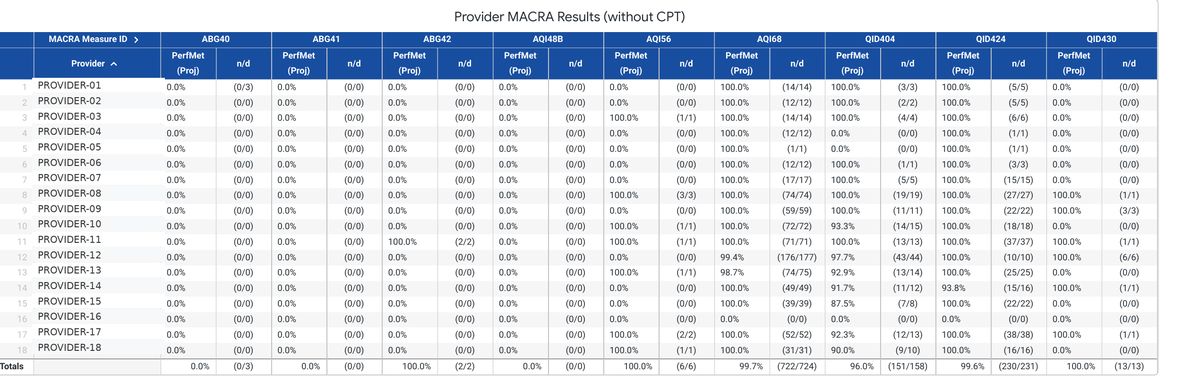
CMS aggregates scores by tax ID, but nobody runs a department at the level of "facilities that share a TIN." We break results down by facility because that's where directors, chiefs, and fixes actually live. Site-level variation becomes visible, and oversight becomes assignable.

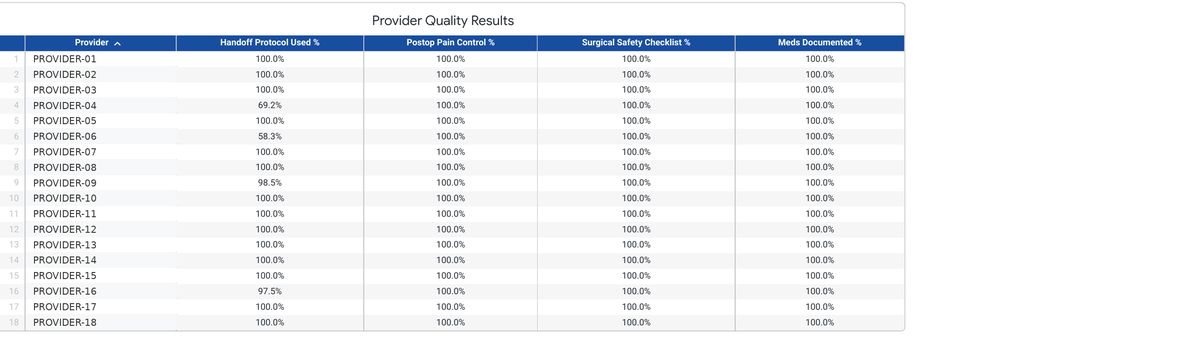
Handoff protocol use, postop pain control, surgical safety checklist, medications documented: not MIPS measures, but exactly the evidence your Improvement Activity attestations and internal QI program need, tracked per provider automatically.
We track more than 40 discrete outcomes, from unplanned cardiac arrest to corneal abrasion to failed regional, and your group can add its own to the list. Rates are shown alongside absolute counts, because at these denominators a single event moves a percentage. Feeds peer review and supports patient-safety Improvement Activity attestations.
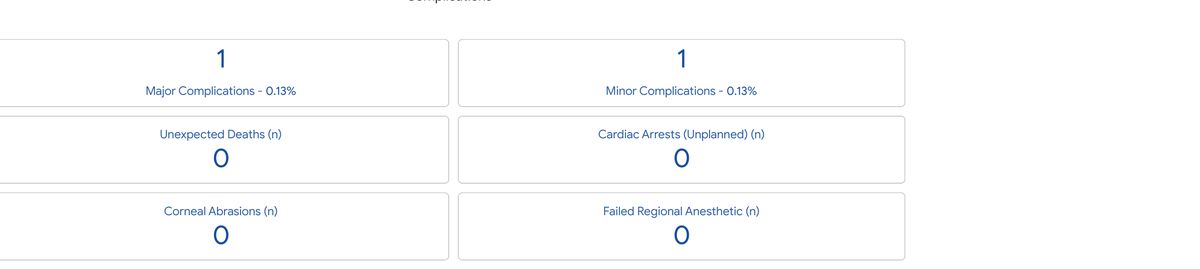
Figures are from a live client scorecard with all identifiers removed. When billing uploads coded cases, CPT codes override provider answers by design: coders classify procedures from the full operative record, so eligibility moving between the two views is the system working correctly.
Reference library
Explore the Graphium educational manuals alongside the approved measure specifications and official qualified posting. The manuals explain the program; CMS guidance and approved specifications govern reporting requirements.
Participation in Graphium QCDR does not guarantee satisfactory participation in the CMS Merit-based Incentive Payment System. Successful submission is contingent upon each eligible clinician or group meeting MIPS program requirements and the timeliness, quality, and accuracy of the data provided. This page is educational and is not practice-management or legal advice.
For the 2026 performance year. Use current CMS guidance alongside these Graphium educational materials.