Deep Dive
What would you like to know about Graphium?
Explore how Graphium fits your clinical workflow, billing process, reporting needs, and facilities. Browse the questions below or search for what matters to your team.
Forms & everyday charting
Familiar forms, an iPad, and an Apple Pencil. Explore how Graphium fits into everyday anesthesia care.
What do your forms actually look like?
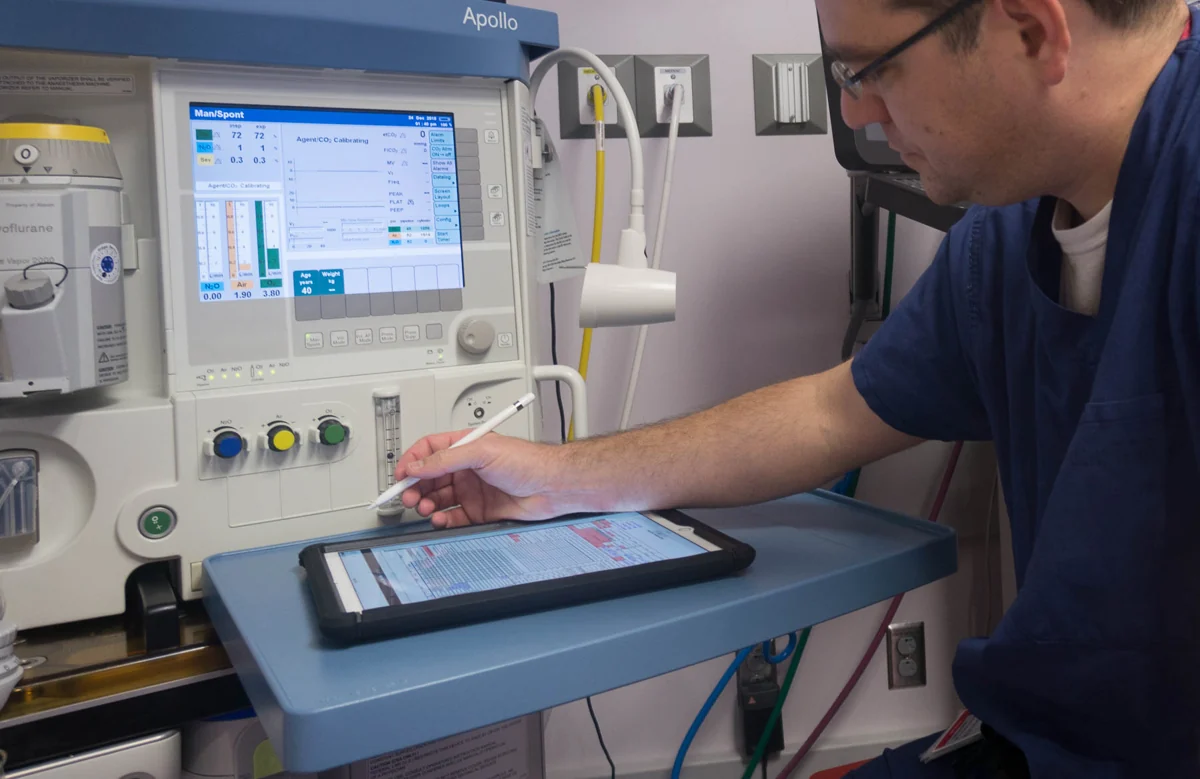
Like the paper record your group already knows, because that's the point. You can see for yourself: our five stock forms (General, Short, OB Labor, OB C-Section, and Cardiac) are free to download as print-ready PDFs and use in your practice, no strings attached. Each is a complete anesthesia record for its service line, and every field on the page maps to a discrete property in our data model, so the paper version and the iPad version are the same design. On the iPad, the required fields turn red until they're completed, vitals chart themselves, and every entry becomes analytics. Want your own layout instead? We digitize it; see the next question.
Can you really digitize ANY paper form?
Yes. Period. Across 100+ organizations we maintain well over a thousand form definitions: general anesthesia, short cases, OB labor and C-section, cardiac, out-of-OR, GI, and forms only one facility on earth uses. English and Spanish consent pages ship today; Spanish is the only other language anyone has ever asked for, and if you need another, we'll build it. Most groups actually start from our stock forms, because their paper hasn't been updated in a decade, and ours keeps the paper feel while quietly capturing every field your analytics will need.
Can we build custom macros, like a one-tap GA induction?
Yes. Macro buttons and templates set any number of fields with a single tap, and we build them per facility during form design. The General record already carries the full airway block as discrete fields: blade, grade, tube size, depth, leak, cuff, stylet, RAE, LTA, and fiberoptic laryngoscope or bronchoscope, plus ETCO₂ and bilateral-breath-sounds confirmation, pre-oxygenation, RSI, and atraumatic intubation. A one-tap GA induction macro can set the airway configuration and your primary induction drugs together. You can add any field to any page of any form.
What's self-serve and what isn't: your dropdown lists (surgeons, medications, blocks, locations, diagnosis and procedure lists) are fully yours to manage in the web dashboard. Form layout changes go through our design team on purpose, and a simple template takes about an hour on our side. Let every site freelance its own form layout and you end up in the Epic situation, where every install is different and your cross-facility benchmarks quietly die.
What's on the Charge Capture form? Can I change it?
Anything you want; it's your claim ticket. We typically start groups on our Simple version (times, providers, procedures, ASA code, a photo of the face sheet) and let them add from there: keep all the quality measures, or take every one off. Your choice. Every field you add feeds the analytics: add a location code and utilization heatmaps light up; add Anesthesia Ready and readiness views appear. Charge Capture data is a subset of the same data model as the full EMR, so nothing you collect is ever stranded.
Can we use AnesthesiaEMR and Charge Capture across different facilities?
Yes. AnesthesiaEMR and Charge Capture use the same app, login, and data platform. The form defines the service line. Groups with mixed facilities run AnesthesiaEMR where paper still rules and Charge Capture where the hospital already owns Epic or Cerner, priced per facility. Patient Satisfaction Surveys and Anesthesia Analytics attach to either, or to neither: surveys can run from a nightly billing export alone.
Can two providers chart on the same case at once?
Yes. Documentation is asynchronous and concurrent; when one provider updates a field, everyone else's view re-renders. Handoffs, relief breaks, and supervising physicians all work the way they do in real life.
How many taps to back-date a drug given during an emergency?
There are no "taps." You write the administration where it belongs on the grid, like you would on paper. Our forms are digital paper on steroids.
Integrations, billing & data
Can you integrate with my billing software?
Graphium delivers a nightly structured text file and case PDFs via SFTP. You can use AnesthesiaEMR at some facilities and Charge Capture at others while your billing team receives the same file format and follows the same workflow. We can share our Standard Integration Specification with your billing team or software vendor to review their import requirements.
ImagineSoftware includes a labeled Graphium import option that automatically creates claims from the structured text file.
Can the finalized PDF route automatically to our EHR, billing team, or cloud storage?
Yes. Finalized records route to your facility EHR as HL7 ORU messages carrying the embedded PDF, on a configurable interval of every 5 minutes, 15 minutes, hourly, or daily, and can be set to transmit only once the form is 100% complete. A separate nightly SFTP handoff bundles each day's case PDFs plus a structured data file for your billing team. Scheduled exports can also deliver to S3, SFTP, webhook, or email, and AirPrint covers facilities whose EHR can't receive automated inbound documents.
Can we keep our existing billing company?
Yes. We work with your existing billing company or internal billing team, providing validated case data and record PDFs. Graphium does not replace your billing company or provide clearinghouse connections, payer contracting, or a coder workstation. If you want an all-inclusive arrangement, we can connect you with a long-standing billing partner.
We handle billing internally. Can you hide the billing/coding screens?
Yes, more cleanly than most, because there's no coder workstation to hide. Graphium isn't a coding platform; billing fields render only where you want them, if at all.
How do you keep incomplete claims from going out?
Incomplete forms never enter the billing feed (configurable per facility), and every morning the daily email names each incomplete form and the provider who owns it. Groups typically reach and hold 100% completion within weeks, because nobody wants to be the name in that email twice.
How do you handle ASA physical status justification?
Chart an ASA 3 or higher and the comorbidity field turns red, requiring an ICD-10 from a list your group controls. The justification travels with the claim, which means fewer downcodes and denials, and no coder emailing providers three weeks later asking why the patient was a 3.
Can we export our data? Is there a fee?
Complete case data exports in XML/JSON, plus scheduled deliveries to S3/SFTP/webhook. We do not put paywalls between you and the data you create.
Is the record you send an editable file or a scan?
Neither. It's a regenerated PDF: the document is rebuilt from the discrete data and handwriting bitmaps, live in the cloud, every time. Write on the iPad and refresh the web view; the PDF already shows it. Nothing is ever scanned, and the nightly billing batch carries per-patient packets (record, face sheet, insurance card, license) plus the structured data file.
Quality & reporting
How does MIPS/QCDR reporting work?
Graphium owns a CMS-licensed QCDR. Quality measures collect automatically as providers chart, performance dashboards run near-real-time all year, and you submit directly to CMS through us, or export AQI-compliant XML to any registry you prefer. Your choice.
How is reporting through Graphium different from a professional society's registry?
The economics and the timing. The membership model charges dues and per-provider registry fees, you submit your data, and you find out how you did when CMS tells you. Our model has no membership dues, no per-provider registry fee, and no annual reporting fee: you pay for the data collection tools your practice already needs (AnesthesiaEMR or Charge Capture), and reporting through our CMS-approved QCDR is included. Because the registry and the charting platform are the same company, your compliance dashboard updates all performance year, per provider and per facility, instead of arriving as an annual receipt. Your internal quality program can include physicians, CRNAs, and CAAs. CMS reporting and payment eligibility are determined separately for each clinician and reporting arrangement.
Can you help with Joint Commission certification?
Yes: quarterly quality reports, pharmacy audits, and form-completion evidence formatted for certification reviews. Joint Commission surveyors have complimented anesthesia teams using Graphium for complete and timely documentation across multiple on-site surveys.
Do we even need to report MIPS?
Not every anesthesia clinician is required to participate in MIPS. Check your CMS participation status for each practice where you bill before deciding how to report.
Voluntary reporting of traditional MIPS does not produce a MIPS payment adjustment. Opting in is different: eligible clinicians who elect to opt in can receive a positive, neutral, or negative adjustment. Group participation can also affect clinicians who are below the individual low-volume threshold.
Whether or not you report to CMS, your quality data can still support internal improvement, benchmarking, and facility discussions.
Implementation, security & company
How long does implementation take?
Weeks, not months, and the honest answer depends on which service line you start with. Patient Satisfaction Surveys: days. Send us a nightly billing export and surveys start going out; nothing changes in your charting. Charge Capture: a few weeks. The claim ticket is designed with your billing team, providers get a one-hour session, and the nightly file starts flowing to SFTP. AnesthesiaEMR: more form work and more training, but we have taken groups live in under 90 days, including one with 84 facilities using about 200 hours of our services in total. A live ADT feed depends on the hospital IT queue, and we don't wait for it: Capture AI reads face sheets from day one, so an integration delay never delays go-live.
Training happens in layers, because that's how anesthesia staffing actually works: a 15-minute custom training video for every provider, a one-hour live online session for the group, and a superuser on site for the first cases. PRN staff get a login by email and a two-minute walkthrough before their first case: scan the wristband, add the form, get rid of the red fields. Fair warning from experience: the video alone still leaves a few things to figure out on the fly. After their first case, they'll understand. The typical full learning curve is 2 to 3 weeks, and our online knowledge base is open 24/7 for the questions that come up at 6 a.m. on a Saturday.
What does onboarding actually look like? What will you ask of us?
We move as fast as you can. A dedicated customer success lead runs the project from kickoff to your first month live, and the pace is set almost entirely by how quickly your side can hand over a short list of things we need.
What we'll ask for: your current paper forms or claim ticket (or a decision to start from our stock forms); a provider roster with credentials and staffing model; the surgeon, procedure, location, and medication lists for each facility; your billing partner's contact and where they want the nightly file delivered; and, if you want them, the integration details for ADT, scheduling, or monitor vitals. iPads or iPhones are yours; we support any MDM you already use.
What we do: build and validate your forms, configure each facility, set up the nightly billing delivery, connect any integrations, and run training in the layers described above. Then a superuser is beside your providers for the first cases, and we review completion rates with you after the first weeks. After go-live, support is a phone call or email away, and the knowledge base covers the how-to questions around the clock.
Every group's plan is a little different, so the specific timeline for yours is one of the things we walk through in a demo.
Is my data secure?
SOC 2 Type II (clean, no exceptions), no PHI stored on devices, no breach history, full audit trails, HIPAA BAAs standard. Full detail on the Security & Trust page.
How much does Graphium cost? Why isn't pricing on the website?
Start with the services your team needs, then add analytics, integrations, or AI capabilities to fit your workflow. Your proposal identifies what’s included and any additional fees. QCDR reporting and security are included.
You're smaller than some competitors. Why should that comfort us rather than worry us?
Because it's a design decision, and you benefit from it twice. The platform scales through automation and self-service rather than consulting headcount (that's how 84 facilities onboarded in 90 days), and the money we don't spend on trade-show booths is why our per-case pricing is the most competitive in the market. Fifteen years, profitable, physician-owned, never acquired. Judge the work: our uptime record lives in public. And support is not a ticket queue: you get a named customer success lead, and a 24/7 knowledge base for everything else.
What's your story? Who is Graphium?
Graphium started in 2011 with a question a practicing anesthesiologist couldn't answer from a paper chart: am I better or worse than my peers? Two clinicians who still practice and the engineers who have built this platform for 15 years set out to answer it with data, and discovered the honest answer needs the whole chain: charting providers don't fight, charges that don't leak, patients whose voices get heard, and analytics that tell you the truth. Anesthesia is the only thing we do. We have never been acquired and never taken venture capital, so the team you buy from is the team you'll renew with. Today Graphium runs in 500+ facilities across 40+ states. The long version, with the people behind it, is on Our Story.
Vitals, devices & connectivity
Which physiologic monitors do you support?
We integrate natively with Neximatic, which covers roughly 95% of monitors in the field, including the Mindray ePM series and GE fleets, and we ingest every field Neximatic captures. If your specific device isn't on the list, they can usually add it quickly. Check Neximatic's current supported-device list yourself.
How do you display ventilator parameters alongside standard vitals?
On the same time-synchronized grid, not in a separate view. The General record graphs EtCO₂, SpO₂, ECG, temperature, TOF, and BIS in the trend band, with tidal volume, mode, PIP/PEEP, and rate as dedicated rows beneath, and O₂, N₂O/air, FiO₂, and inspired/expired agent percentages above. With a monitor connected, all of it populates automatically.
What about logins, devices, and MDM?
Per-user logins with a 4-digit PIN for fast OR re-entry (three failures forces a full sign-in). iPad for the EMR, iPhone for charge capture; the app is in the App Store but useless without an account. One login works across all your facilities via a facility switcher, with PHI segregated per facility and role-based access (provider, biller, admin, org admin). MDM supported; we'll send a recommended-hardware list. You don't need the $1,200 iPad Pro, but don't buy $99 knockoffs either.
What happens to vitals during a network outage?
Supported physiologic monitors connect through Neximatic. After a temporary connection interruption, available vital-sign data can backfill into the chart at its original timestamps. Recovery depends on which connection was interrupted and the data available from the monitor integration; follow your facility’s downtime procedures and review the recovered record.
If the iPad loses internet mid-case, can providers keep charting offline?
AnesthesiaEMR requires a network connection for electronic charting. Graphium’s iOS apps send field entries directly to the cloud and do not persist patient data to local storage on the device.
The app DOES ride out transient blips (Wi-Fi handoffs, brief signal loss) with in-memory retry, and we run connectivity assessments at facility, location, and device level before go-live to fix actual dead spots. Meanwhile, monitor vitals keep recording independently and backfill automatically (see the vitals question above).
During downtime, your team can chart on the paper version of the form, then photograph it for the record. Where Capture AI is configured for this workflow, it can extract information from the image for review. Required-field checks support complete electronic documentation; downtime cases use a separate completion workflow.
Can the iPad generate the final record PDF while offline?
No. Document generation is server-side, a consequence of the same online-first architecture: the chart's source of truth lives in the cloud, never on the tablet. The practical upside is that anyone with access can generate the PDF at any time from any web browser, with the most recent saved data, without hunting down the iPad the case was charted on.
Is there an Android or web charting app?
No. The clinician charting apps are iOS (iPad and iPhone). Everything else (dashboards, analytics, record retrieval, administration) runs in any web browser.
Special workflows & product scope
Most of our cases are at Epic or Cerner facilities. Isn't a claim ticket just one more thing for providers?
Yes. We won't pretend otherwise: at a facility whose EMR we don't replace, the claim ticket is a new step, about a minute on a phone the provider already carries. Here's why large groups do it anyway. First, consistency: every hospital's Epic asks different questions, so running one quality program across many facilities from inside their EMRs is nearly impossible; the claim ticket asks YOUR questions the same way everywhere. Second, ownership: the data lands in your platform, not scattered across hospital systems you'll never get exports from. Third, oversight: you finally have your own count of what was performed, upstream of billing. Some of the largest groups in the country simply made the ticket policy. And where a facility will cooperate, a custom interface can remove the manual step entirely.
Does AI suggest CPT or ICD codes?
No. Capture AI reads documents (face sheets, insurance cards) into structured data at 90–95% accuracy; charge codes come from dropdowns your billing team approves. Coding judgment stays human.